Career Prospects of IMGs in the UK’s Post-UKMG Prioritisation Era
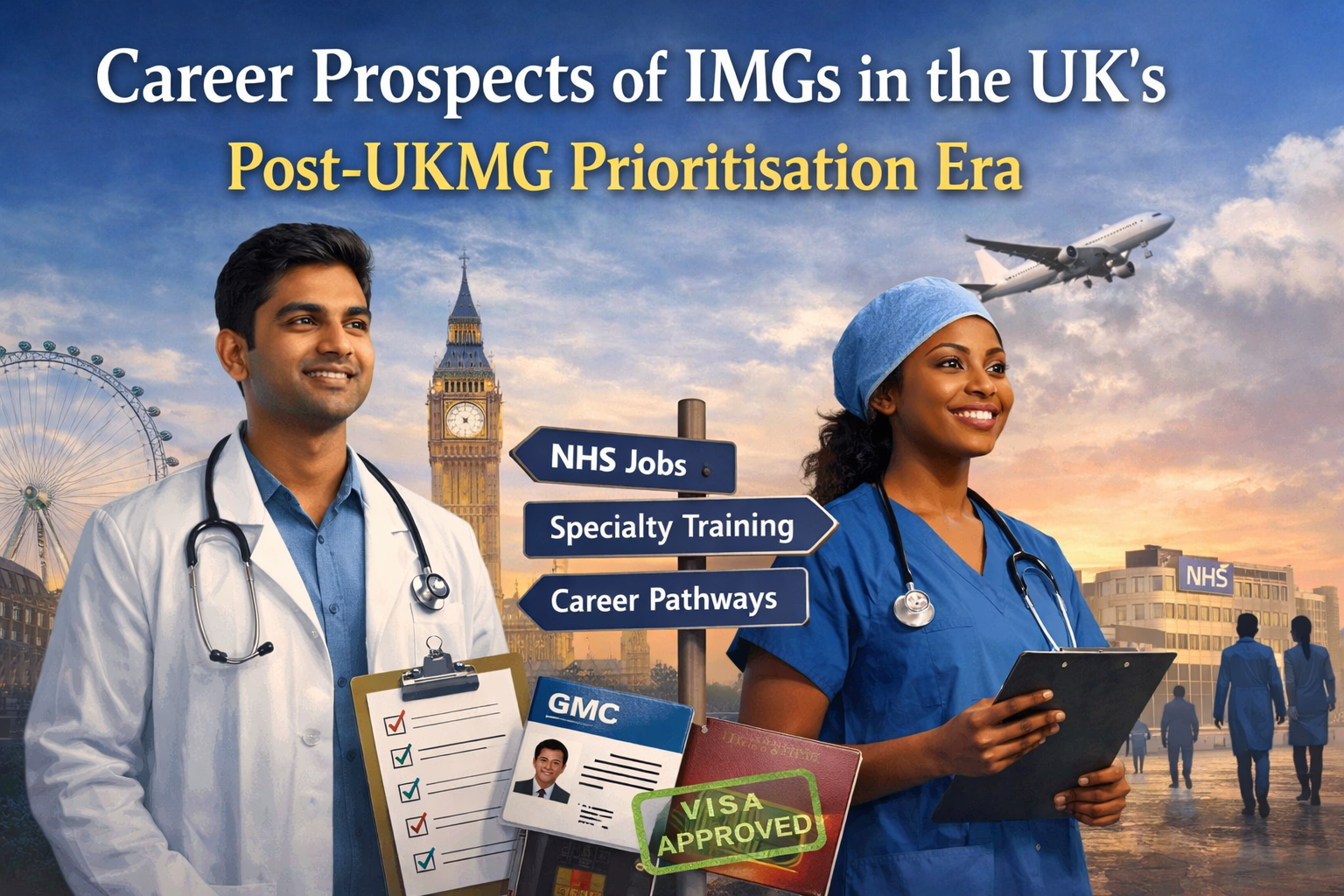
IMGs
How the relationship started
Overseas doctors or international medical graduates(IMGs) have always been part of the UK’s health system before the creation of the UK’s national Health Service in 1948. The presence of overseas doctors in the UK was part of various arrangements of the British Empire, with its former colonies under the Commonwealth countries' umbrella. There is credible evidence that shows that IMGs ' presence in the UK’s health system can be traced back to 1800 as part of colonialism. Until the 1930s, the number of IMGs in the UK health system was not statistically significant, for lack of a better word. The indirect impact of World War I and the direct impact of World War II contributed to medical workforce shortages, culminating in the formation of the NHS in 1948. Interestingly, by 1952, it was reported by Julian that 12% of the NHS medical workforce was made up of overseas doctors.
The introduction of the PLAB (Professional and Linguistic Assessments Board) assessment by the UK’s General Medical Council in 1975 ushered in the era of the expansion of IMGs, mainly from the so-called big 5 commonwealth countries: India, Pakistan, Egypt, Nigeria and Ireland(now ex-Commonwealth). Expansion in IMG numbers will continue largely in the 2000s and around the covid pandemic in 2020.
Start of the reset of the relationship
On June 25th 2025, the BMA resident doctors’ committee passed the BMA speciality training policy that stated that it will lobby the government to prioritise UK Medical Graduates for speciality training. Six months later, prioritisation was codified as part of the NHS 10-year plan and put forward by the government as part of the offer to the BMA to avert a strike, even though 33% of BMA members are IMGs. As part of the process, the government will repurpose the contracts of many locally employed doctors contract mostly filled by IMGs, to bolster speciality training places.
The GMC’s 2025 workforce report highlighted key changes to the recruitment relationship between the UK and IMGs. It notes the following important information, which states that 42% of all doctors in the UK are IMGs, and in terms of competition for speciality training places, the non-UK proportion of all those who receive offers has increased. In 2018/19, international from 26% in 2018/2019 to 34% in 2023/24. Furthermore, PLAB no longer guarantees employment in the UK. In 2024, far fewer had obtained employment within six months compared to previous years, indicating a contracting employment market for IMGs in the UK.
On the 13th of January 2026, the Secretary of Health and Social Care, Wes Streeting MP, proposed the Medical Training (Prioritisation) as emergency legislation. On the 28th of January, Baroness Gillian Joanna Merron, a Life Peer of the House of Lords, got the legislation through its house due process approved by the Lords and by the 5th of March 2026, received royal assent to become an act of UK law.
Future of the relationship
IMGs globally pursue medical careers in many countries. According to the OECD report, the United States, the UK and Germany account for the highest absolute number of migrant doctors, comprising 56% of all migrant doctors in the OECD. The next group is Australia, Canada and the Republic of Ireland. We cannot fail to mention the impact of Middle Eastern countries, the United Arab Emirates, Saudi Arabia, Qatar, Kuwait and Oman on the international doctors migration market, as even the GMC also affirms it. Based on the information and insights available, it is safe to say the UK is clearly going to recruit fewer and fewer IMGs in the coming years, at least for the foreseeable future. However, with that said, this by no means means the door is completely shut to IMGs, but it is pertinent to carefully consider all the factors before committing long-term to any country, including the UK, through a well-informed process that is appropriate to your individual personal circumstance.
Our advice at Laj Academy
Our team of experts with many years of experience in medical education and clinical practice across many health systems in the UK, US, Canada, Australia, the Middle East and Africa has reached a consensus that the best approach for an IMG in the UK and other health care systems in any country is to take the portfolio approach to their career in that way they build long lasting skills that are translatable and transferable anywhere in the world including their country of origin. Through many years of academic experience and expert input, we developed a portfolio-building approach called CREATE Evidence
Clinical Experience
Gain as much clinical experience in the speciality of interest that you are interested in, and keep the clinical gap to a minimum. Do this in your country and the target country of interest through paid and unpaid options like observerships, clinical attachment, visiting doctor or honorary doctor, etc
Research
Do a fundamental research training as early in your career as possible i.e INTRODUCTION TO RESEARCH, AUDIT & TEACHING(RAT) FOR IMGs
Participate, lead and publish research in high-impact peer-reviewed journals, aiming for 1-2 articles per year. Join clinical trials and do the fundamental research training needed as early in your career as possible
Exams
Pass the relevant speciality of the medical licensing examination as soon as possible, and be very targeted with the exams you choose to sit for.
Audit(Clinical)
Participate, lead and present your clinical audits and quality improvement programmes in your country and target country, aiming for 1-2 audits per year. Join clinical audit teams and do the fundamental research training needed as early in your career as possible.
INTRODUCTION TO RESEARCH, AUDIT & TEACHING(RAT) FOR IMGs
Teaching
Complete a short formal teaching course and start getting involved and delivering teaching to medical students and other doctors regularly, aiming for at least 1 teaching every 3-4months.
INTRODUCTION TO RESEARCH, AUDIT & TEACHING(RAT) FOR IMGs
Education
Aim to complete some type of additional postgraduate degree at some point during your career, of course, the earlier the better, to make you more competitive and give you a better skill set. In addition, maintain your medical knowledge through continuous medical and professional education
Evidence
Gather high-quality verifiable evidence along the way and keep it safe.
For those who choose to pursue their career, we have a lot of helpful resources that will help them on their NHS career journey, starting with the job application Start2Finish Guide To Applying For NHS Jobs By Anyone From Anywhere. This video explains the step-by-step process of the NHS job search using the Trac portal. This is followed by two more training were we did a deeper dive into job search in the UK devolved nations with additional insights in the following video NHS JOB SEARCH for IMGs Basics I and followed by its sequel NHS Job Search for IMGs Basics II. In other job videos, we address issues with recruitment, like the issues of being on the red recruitment list HOW TO GET THE NHS JOB OF YOUR DREAM AS AN IMG, as well as contrasting that with the opportunities and unfilled medical roles in the UK NHS Challenges & Insights for IMGs Seeking NHS JOBS: A Must Watch, and we completed the NS job series with two well-attended expert panel webinars NHS Job Hunt for IMGs Part I and Mastering NHS Job Hunt for IMGs Part II. These have a wealth of experience and knowledge to help navigate you in the right direction in your NHS career journey.
Please also check our training for IMGS at the lajcademy to give yourself the best chance of success
https://www.lajacademy.co.uk/services-store
Goodluck!!!
